Bringing responsible sourcing to the artisanal mine.
EPRM is a partnership, not an agency: European governments, brand-name manufacturers and civil-society organisations sitting on one board, with a secretariat inside the Dutch government and a grant window pointed at artisanal mines in high-risk countries. Constituted in 2016 around conflict minerals, it opened its funding to cobalt, copper and lithium in 2023 — and several of the projects it now finances are in the Congolese copper-cobalt belt.
Visit europeanpartnership-responsibleminerals.eu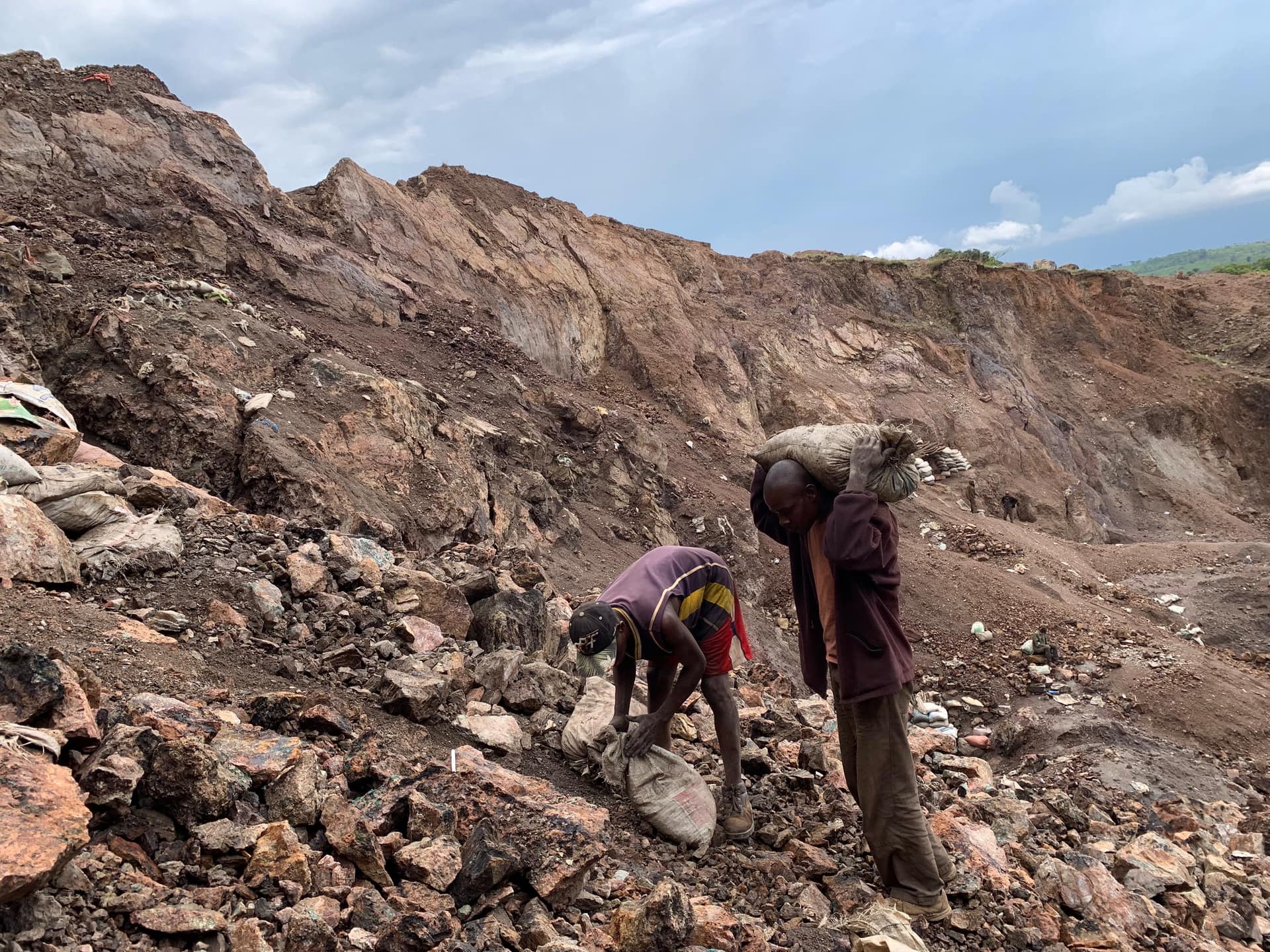
Artisanal cobalt miners at work in the Democratic Republic of the Congo.
Photo: The International Institute for Environment and Development (IIED), via Wikimedia Commons — CC BY 2.5
A partnership with a board, a secretariat and no legal body of its own.
EPRM was founded at the end of 2016 as a development-policy accompaniment to the EU’s conflict-minerals regulation: the regulation told European importers of tin, tantalum, tungsten and gold what they had to prove, and EPRM was set up to help the mines at the far end of those chains become provable. It describes itself as “a multi-stakeholder initiative fostering reliable and responsible mineral supply chains through inclusive and knowledge-driven engagement with artisanal and small-scale mining (ASM) in high-risk areas.”
It is governed by a board drawn evenly from its three constituencies — governments and institutions, supply-chain actors, and civil-society organisations — with the chair and a share of the seats rotating each year. The European Commission’s DG INTPA, the OECD, the ICGLR and the World Bank sit as observers. The executive arm is a secretariat commissioned to the Netherlands Enterprise Agency, which runs the money, the memberships and the calls for proposals.
What it does not have is a legal form of its own. No registration, seat or statute for EPRM is published anywhere we could find, and its entire grant portfolio is reported to the international aid-transparency standard under the Dutch agency’s own chamber-of-commerce number rather than any EPRM identifier. Its funding is administered as a Dutch subsidy scheme, and membership applications go to an address at the agency. The partnership is real and its money is traceable; the body behind it is the agency that holds the pen.
Members pay in differently by constituency. Governments contribute money, and governments of producing countries may join as observers without paying. Companies pay annual fees scaled from €1,500 for a small enterprise to €30,000 for a strategic member. Civil-society members contribute 120 hours a year in kind, observers 48. Admission runs through a secretariat assessment, a circulation to the membership and a board decision.
One board, one secretariat, three constituencies.
- Governments and institutions, supply-chain actors, and civil-society organisations each hold seats on the Governance Board.
- The Governance Board’s executive arm is the Secretariat, hosted by the Netherlands Enterprise Agency (RVO), which runs the money, the memberships and the calls for proposals.
- Observers sit beside the Governance Board without a vote: European Commission (DG INTPA), OECD, ICGLR and World Bank.
- Funders flow money into the grant window the Secretariat runs: the Dutch Ministry of Foreign Affairs, the European Union through DG INTPA, and the UK’s Foreign, Commonwealth & Development Office.
- The Secretariat’s grant window funds three projects mapped on this Hub: Holistic Due Diligence, Cobalt Credits and MAX-D.

The KOV open-pit copper-cobalt mine at Kolwezi.
Photo: Martin Tuchscherer, via Wikimedia Commons — CC BY-SA 3.0
The grant window, and the work around it.
It funds mine-site projects.
A call for proposals awards grants — in the published portfolio, between €163,379 and €800,000 — to consortia that help artisanal mining communities adopt better practice and build durable links to formal supply chains. Twenty-seven such grants are published, across sixteen countries.
It equips companies to do due diligence.
A Due Diligence Hub aggregates tools by supply-chain tier and mineral; a self-assessment check scores a company against the OECD’s five steps and tells it where it is weakest; case studies circulate what worked. That side of the work is still built around tin, tantalum, tungsten and gold.
It puts the two ends in a room.
Convening is a job in its own right: linking upstream producers to downstream buyers, running the conferences, and turning what the funded projects learn into something the membership can act on.
Active, and a decade old.
EPRM marked ten years in June 2026 with a conference in Amsterdam. Its own pages and news have carried updates through 2026, and the projects it funds are independently visible both in the reporting of the organisations that run them and in the Dutch agency’s published programme data, refreshed in September 2026. That is what puts it inside this Hub’s test for an active initiative.
The change that matters here is the 2023 call. EPRM was built around tin, tantalum, tungsten and gold, and its Due Diligence Hub still is. But the 2023 call for proposals covered tin, tantalum, tungsten, lithium, natural graphite, cobalt, copper and nickel, and the projects that came out of it put EPRM money into the Congolese copper-cobalt belt for the first time. Four of its funded projects now touch cobalt; three of those are in, or partly in, the DRC.
What it does not publish is a budget. There is no annual figure, no donor breakdown and no accounts on its site. What can be traced is project by project, through the Dutch agency’s aid-transparency data: twenty-seven published grants between €163,379 and €800,000, coming to €10.57m in total. That sum is a floor and not a budget — it excludes four projects EPRM’s own site names and the agency’s programme does not carry, and it excludes secretariat costs.
Two things on its own site do not agree with each other, and this page carries neither as a figure. EPRM’s membership page says the partnership has more than fifty members, while the overview it publishes names forty-three organisations and five observers; the names are below, and the count is not. And how much of the world’s cobalt comes from artisanal mining is stated one way on its About page and another, lower way on its own 2024 page on energy-transition minerals, citing two named studies; with EPRM’s own material in disagreement, this Hub carries no figure for it.
Two project locations are contested the same way. EPRM places its CADD project in the DRC and Burkina Faso; the agency’s programme data places it in Burkina Faso and Bolivia. EPRM describes “Promoting Responsible Mineral Supply Chains” as a Ugandan project; the agency lists the DRC, Uganda and Rwanda. Both accounts are named here and neither is merged into the other.
The constituencies, and the bench of observers.
Members join through one of three constituencies, each with its own guidelines and its own seats on the board. These are the organisations EPRM’s published overview names.
 BMZ (Germany)
 Ministry of Foreign Affairs (Netherlands)
 FCDO (United Kingdom)
 Ministère de l’Europe et des Affaires étrangères (France)
 Cisco
Cisco Fairphone
 HP
HP Inforlandia
 Intel
Intel International Tin Association
 Gold by Gold
 MMR
MMR NXP
NXP Philips
 Responsible Mica Initiative
 Responsible Minerals Initiative
 Samsung
 SHIFT
SHIFT Teknoservice
 TP Vision
 Fairalloy
 Fairever
 Siemens Energy
 LuNa Smelter
 Groupe Pochet
 Valcambi
 AFREWATCH
 Alliance for Responsible Mining
 Pact
Pact Diakonia
 Global Communities
 IIED
IIED IGF
IGF IISD
IISD IPIS
IPIS The Impact Facility
 IMPACT
 Solidaridad
 Terre des Hommes
 Red Social (Peru)
 International Women in Mining
 Responsible Sourcing Network
 European Commission (DG INTPA)
 OECD
OECD ICGLR
ICGLR World Bank
Observers on EPRM’s governance page are the European Commission’s DG INTPA, the OECD, the ICGLR and the World Bank; UNEP appears as a fifth observer elsewhere on the same site. Funding comes from the Dutch Ministry of Foreign Affairs, the European Union through DG INTPA, and the UK’s Foreign, Commonwealth & Development Office; Germany joined as a member in January 2020 and France sits on the 2025 board.
The funders behind the projects.
EPRM finances several of the programmes mapped here. Browse the full register, or tell us what is missing.