Proving artisanal cobalt can meet the standard.
A GIZ-run, industry- and EU-funded pilot in Lualaba that set out to show an artisanal cobalt mine can operate to international health, safety and environmental standards, and to bring the first such mine to life under the 2018 Mining Code.
Visit cobalt4development.com View its entry in the sector data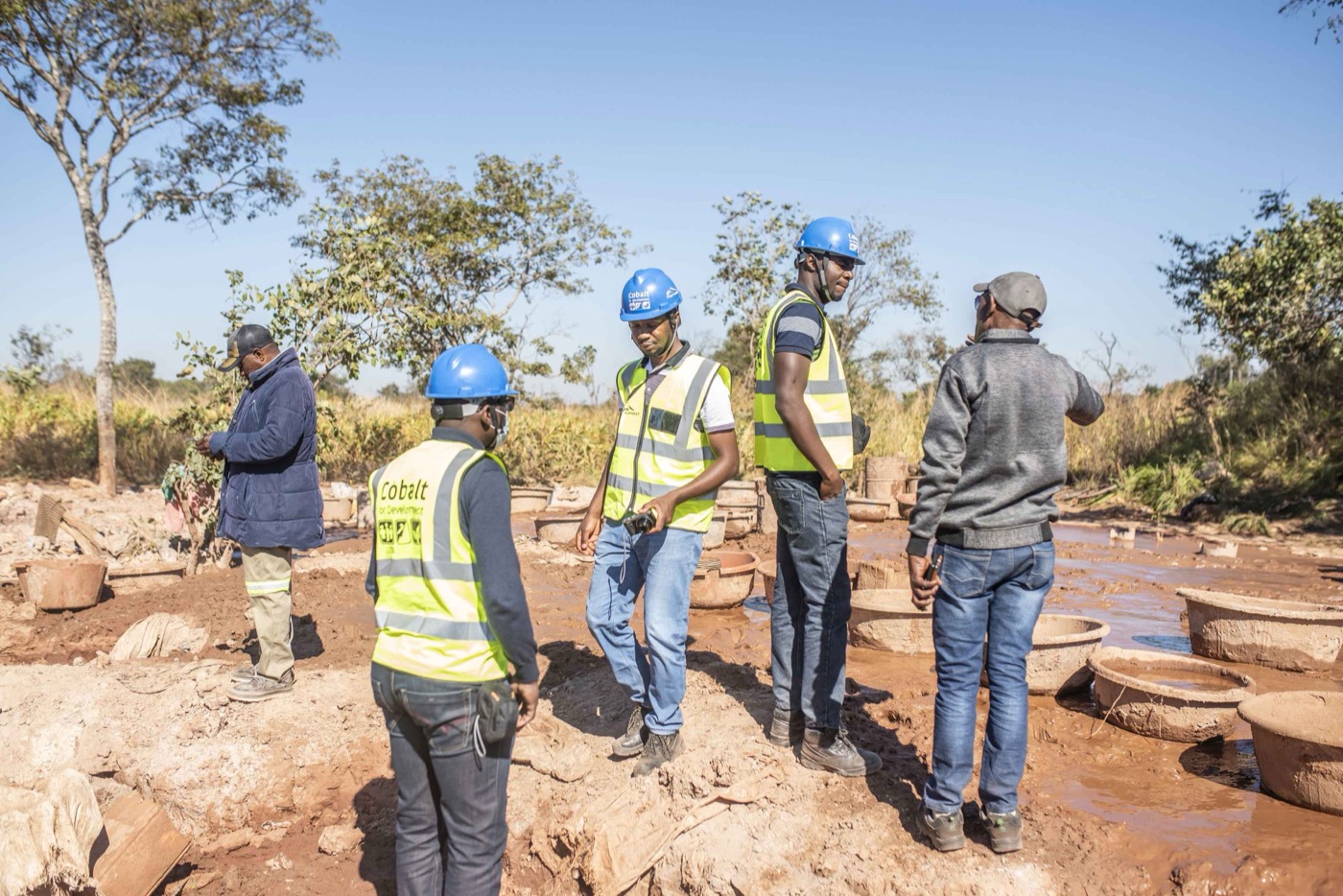
A pilot to formalise one mine, as a model for many.
A pilot to formalise one mine, as a model for many.
Cobalt for Development describes itself as a voluntary, cross-industry initiative working to transform artisanal and small-scale cobalt mining in Lualaba Province: to show it can meet international standards for health, safety and the environment, improve living and working conditions, and help formalise the sector. GIZ implements it on behalf of, and funded by, participating companies, and pursues no commercial interest of its own.
It answers the risks in artisanal cobalt that Amnesty International and others had documented: BMW commissioned a GIZ feasibility study (2018–2019), and C4D launched in 2019 as a cross-industry initiative. None of the funding companies mine or buy the minerals from the sites; the aim is an independent demonstration, framed throughout by the OECD Due Diligence Guidance.
The early work paired a mining track with a community programme in the village of Kisote: a new school building, savings groups, farming and family support, which brought gains by C4D's account, though some activities were not sustained by the community after the project closed. The mining pilot proved harder. The first candidate site at Kisote was abandoned when drilling showed the cobalt lay too deep for artisanal extraction, beginning a years-long search for a workable legal site.
That search is the heart of the C4D story. After failed attempts on an industrial concession, it converged in 2024 on Tombolo, a site subleased by Gécamines to the state cobalt company EGC, which C4D has brought to the point of a final investment decision; that decision is pending. The timeline traces how the pilot got there.
Lessons from the project.
C4D’s reporting states that private-sector due diligence can open space, but only governments drive lasting reform. The pilot at Tombolo followed an act of Congolese policy: Gécamines subleasing the site to EGC. C4D's paper adds that a decree, which it calls “a ministerial decree by President Tshisekedi”, recognises the EGC pilot as a priority; the paper gives no date, and the decree's text has not been found.
Part of its work is capacity: five training modules, co-developed with SAEMAPE and BGR and benchmarked internationally, are now built into SAEMAPE's curriculum, with government agents trained as trainers, so the training can continue after the project's funding ends.
The missing piece, in C4D's own words, is market access: until responsible artisanal cobalt is rewarded over black-market prices, formalisation has no lasting incentive.
What it is
Cobalt for Development (C4D) is a development project on artisanal cobalt mining in the DRC’s Lualaba province. GIZ implements it on behalf of the companies that fund it, and its paper describes two tiers of governance: lead partners and contributing partners. The paper states that the project pursues no commercial interest and that none of its partners buys artisanal material; its former website said the project “neither operates the artisanal mines nor does it purchase or sell cobalt.”
Its phases run from a fact-finding mission in 2018 through C4D I (2019–2022) and C4D II (2023–2025) to a continuation approved in late 2024, which the paper says lets it sustain technical assistance until early 2028. Its office is at Avenue Kalima 426, Quartier Mutoshi, Commune Manika, Kolwezi.
Its former website gave two different miner-count figures for artisanal cobalt in the DRC: “Up to 20% of Congolese cobalt is mined artisanally by 50,000 to 150,000 self-employed miners,” and, elsewhere on the same site, “Up to 100,000 – 200,000 Congolese women and men directly work in artisanal cobalt mining.” Both figures are the project’s own, from its own former home page, and neither is resolved into the other here.
3 sources
- Cobalt for Development – Lessons Learned Paper ↗
The project is implemented by the Deutsche Gesellschaft für Internationale Zusammenarbeit (GIZ) on behalf of and with funding from the participating companies.
- Cobalt for Development (former website, home) ↗
The project neither operates the artisanal mines nor does it purchase or sell cobalt.
- Cobalt for Development (C4D) – Towards responsible artisanal cobalt mining in the DR Congo ↗
Implemented by GIZ and co-funded by BASF, BMW Group, the European Union, and Stihl, C4D supports the EGC and government partners
Role in DRC cobalt
C4D sets out to show that artisanal cobalt can be mined to international health, safety and environmental standards, and to help formalise the sector through a legal pilot site that others can copy. It works on three principles its paper names: legality first, with no permanent presence or equipment at illegal sites; an “honest broker” role between the state, companies and miners; and the OECD’s six-step due-diligence cycle, applied step by step.
Its current website presents it as linking responsible artisanal producers to downstream markets and as aligned with the EU’s Global Gateway, the Critical Raw Materials Act and due-diligence standards. These are its own claims.
2 sources
- Cobalt for Development – Lessons Learned Paper ↗
The project is implemented by the Deutsche Gesellschaft für Internationale Zusammenarbeit (GIZ) on behalf of and with funding from the participating companies.
- Cobalt for Development (C4D) – Towards responsible artisanal cobalt mining in the DR Congo ↗
Implemented by GIZ and co-funded by BASF, BMW Group, the European Union, and Stihl, C4D supports the EGC and government partners
Contested
Sources disagree on these questions. Each side is given as its own source states it.
Which funders continued past 2024
C4D’s paper: at the late-2024 continuation “BMW Group, BASF and Stihl remained partners, Renault joined”.
1 source
- Cobalt for Development – Lessons Learned Paper ↗
The project is implemented by the Deutsche Gesellschaft für Internationale Zusammenarbeit (GIZ) on behalf of and with funding from the participating companies.
The training modules published on 19 May 2025 were made on the mandate of BASF, BMW Group, Samsung Electronics, Samsung SDI, STIHL and Volkswagen Group.
1 source
- Module 1 : Administration et gestion de l’exploitation par la coopérative minière ↗
Constitué de cinq modules rédigés en français et accompagnés d’exemples concrets
Volkswagen’s 2024 annual report still called it a project partner of C4D, “so far open-ended”; its report published in March 2026 says it decided to withdraw.
2 sources
- Annual Report 2024: Workers in the value chain ↗
a project partner of Cobalt for Development
- Responsible Raw Materials Report 2025 ↗
following thorough evaluation, the Volkswagen Group has decided to withdraw from C4D.
Samsung SDI’s 2025 sustainability report says that through C4D “we have been actively working to improve working conditions”.
1 source
- 2025 Samsung SDI Sustainability Report ↗
for cobalt, 23 out of 25 smelters have been verified as RMI-conformant.
Whether Google funded C4D
Volkswagen’s release of 19 November 2020 says the project is financed by BASF, BMW Group, Google, Samsung Electronics, Samsung SDI and Volkswagen; MINING.COM’s article of the same day copies it word for word.
2 sources
- Volkswagen joins cobalt group supporting artisanal DRC miners ↗
The project is being implemented by GIZ and financed by BASF, BMW Group, Google, Samsung Electronics, Samsung SDI and Volkswagen.
- Volkswagen engages in improving working conditions in artisanal cobalt mines in the Democratic Republic of Congo ↗
The project is being implemented by GIZ and financed by BASF, BMW Group, Google, Samsung Electronics, Samsung SDI and Volkswagen.
BASF’s release of 30 October 2020 names the four companies that commissioned GIZ and says Volkswagen joined in 2020, with no mention of Google; the Bon Pasteur plan’s list of C4D’s companies omits Google too.
2 sources
- P-20-350: “Cobalt for Development” project started trainings ↗
to implement this fully privately financed cross-industry initiative. In 2020, Volkswagen joined
- Bon Pasteur Kolwezi Theory of Change – Strategic Plan 2024-2028 ↗
including Misean Cara, ERG, Mercedes Benz, GIZ, Missio Austria, Google, Begeca and Manos Unidas.
Who funds C4D
C4D’s paper and BASF describe GIZ as the implementer, acting on behalf of and with funding from the participating companies.
2 sources
- Cobalt Initiative – Cross-industry partnership to enhance sustainable cobalt mining ↗
In January 2019, the companies BASF, BMW, Samsung Electronics and Samsung SDI commissioned the Deutsche Gesellschaft für Internationale Zusammenarbeit (GIZ) GmbH
- Cobalt for Development – Lessons Learned Paper ↗
The project is implemented by the Deutsche Gesellschaft für Internationale Zusammenarbeit (GIZ) on behalf of and with funding from the participating companies.
The US Embassy’s release of 14 January 2025 calls C4D “the GIZ-funded project”.
1 source
- U.S. Joins Partnership to Promote Responsibly Sourced Artisanal Cobalt ↗
the GIZ-funded project Cobalt 4 Development (C4D)
When the Kisote pilot stopped
C4D’s paper, p.20: in December 2019 the economic viability of ZEA Kisote collapsed and work on the pilot was discontinued; drilling showed the deposits too deep for artisanal extraction.
1 source
- Cobalt for Development – Lessons Learned Paper ↗
The project is implemented by the Deutsche Gesellschaft für Internationale Zusammenarbeit (GIZ) on behalf of and with funding from the participating companies.
The same paper’s chronology, p.14, dates the cancellation of the pilot to 2020, “due to geological result of Kisote”.
1 source
- Cobalt for Development – Lessons Learned Paper ↗
The project is implemented by the Deutsche Gesellschaft für Internationale Zusammenarbeit (GIZ) on behalf of and with funding from the participating companies.
The funders’ joint release of 30 October 2020 still described a site next to Kisote as under evaluation, and the World Economic Forum’s September 2020 report said that, as of June 2020, the site was “still not operational”.
2 sources
- Joint News Release: “Cobalt for Development” project started trainings for mining cooperatives ↗
The initiative intends to train more than 1,500 artisanal cobalt miners by mid-2021.
- Making Mining Safe and Fair: Artisanal cobalt extraction in the Democratic Republic of the Congo ↗
the Kisote project has a budget of approximately $5 million, which is exclusively financed by several major multinational companies, including BMW, BASF
When the community component ended
The Bon Pasteur plan: “Since the conclusion of the project in 2022”.
1 source
- Bon Pasteur Kolwezi Theory of Change – Strategic Plan 2024-2028 ↗
including Misean Cara, ERG, Mercedes Benz, GIZ, Missio Austria, Google, Begeca and Manos Unidas.
C4D’s paper: residents gained access to services “until the beginning of 2023”, when the component ended as planned.
1 source
- Cobalt for Development – Lessons Learned Paper ↗
The project is implemented by the Deutsche Gesellschaft für Internationale Zusammenarbeit (GIZ) on behalf of and with funding from the participating companies.
The community results
C4D’s paper, p.27 (graphic): 544 people trained in financial literacy, 1,359 in positive parenting, 40 cases resolved, 89 businesses started, 95% of children enrolled in primary school against a 70% baseline, household income up 36% and savings up 47%.
1 source
- Cobalt for Development – Lessons Learned Paper ↗
The project is implemented by the Deutsche Gesellschaft für Internationale Zusammenarbeit (GIZ) on behalf of and with funding from the participating companies.
The same paper, p.34 (text): 493 people trained in financial literacy, 1,122 in parenting and conflict resolution, 20 disputes resolved, 89 businesses started, and school attendance in Kisote up from 70% (2019) to 95% (2022), 25 percentage points. P.34 measures attendance where p.27 measures enrolment.
1 source
- Cobalt for Development – Lessons Learned Paper ↗
The project is implemented by the Deutsche Gesellschaft für Internationale Zusammenarbeit (GIZ) on behalf of and with funding from the participating companies.
What module 5 covers
C4D’s paper, p.28: a fifth module was created “focusing specifically on safety issues related to deep pits”, backed by a deep-shaft survey that is unpublished.
1 source
- Cobalt for Development – Lessons Learned Paper ↗
The project is implemented by the Deutsche Gesellschaft für Internationale Zusammenarbeit (GIZ) on behalf of and with funding from the participating companies.
The published module 5 is a general course on artisanal mining techniques, from the mining cycle to mine closure, which includes sections on underground mining and underground structures (pp.52–64).
1 source
- Module 5 : Techniques d’exploitation minière artisanale ↗
Le module s’adresse avant tout aux gestionnaires de coopératives et aux exploitants miniers artisanaux.
Criticism
December 2025
C4D’s own paper lists its failures: it underestimated the Mining Code and the legal framework; governance and vested interests, including smelters sourcing informally and officials profiting, held the pilot back; the geology at Kisote failed; cooperatives distrusted incident data, weakening outcome monitoring; and after the project closed, farmer associations and savings groups were not sustained, so that social activities no longer mitigated supply-chain risks.
1 source
- Cobalt for Development – Lessons Learned Paper ↗
The project is implemented by the Deutsche Gesellschaft für Internationale Zusammenarbeit (GIZ) on behalf of and with funding from the participating companies.
- Cobalt for Development – Lessons Learned Paper ↗
June 2024
A University of Amsterdam thesis found that the evidence for the project’s safety work came mainly from C4D’s website “not from an unbiased reporting source”. In interviews for it, C4D’s project director called the media’s portrayal of children in the mines “fake news” while acknowledging that adolescents of 16 and 17 still work at the sites. C4D’s paper of December 2025 (p.16) reports the worst forms of child labour at the sites of its feasibility study.
2 sources
- Cobalt for Development – Lessons Learned Paper ↗
The project is implemented by the Deutsche Gesellschaft für Internationale Zusammenarbeit (GIZ) on behalf of and with funding from the participating companies.
- Formalizing Artisanal Cobalt Mining in the DRC (MSc thesis) ↗
it must be recognized that this evidence was mainly retrieved from the C4D website, not from an unbiased reporting source.
- Cobalt for Development – Lessons Learned Paper ↗
27 May 2026
Writing after 49 artisanal miners died in a trench at Kalando in November 2025, two researchers argue that formalisation through ZEAs, cooperatives and state agencies such as SAEMAPE is presented as the magic solution, and that the same “depoliticisation” is at work in responsible-cobalt initiatives that focus on visible and emotional risks such as child labour.
1 source
- The miners’ anger ↗
This depoliticisation is also at work in ‘responsible cobalt’ initiatives, which focus on visible and emotional risks (such as child labour)
- The miners’ anger ↗
Open questions
- The trainer slide decks, the 19 risk-management tools, the draft blueprint, the July 2023 position paper and the deep-shaft survey behind module 5 are unpublished.
- C4D coached cooperatives at Shabara, Kisanfu and Tilwezembe (2019–2023) and assessed Mwilu, UCK-Dran and Kawama; each name matches a site on this hub only approximately, so the identity question is open and no link is drawn.
- USAID announced a partnership with EGC, Gécamines, the RMI and C4D in January 2025; the announcement could not be re-opened this round, and C4D’s paper says engagement was discontinued after USAID’s 2025 restructuring and its decision to fund nothing.
- The project’s results figures are its own and unaudited; the hub holds no independent evaluation of the project.
Its connections across the sector
Every organisation and site the sector data connects to it, grouped by the kind of link. Each name opens its own page, with the dates and sources of the link.
Funders
Implementers
Partners
Exchanges with
- AFREWATCH
- Cadastre Minier (CAMI)
- Cellule Technique de Coordination et de Planification Minière (CTCPM)
- Centre d’Expertise, d’Évaluation et de Certification des Substances Minérales Précieuses et Semi-Précieuses (CEEC)
- DRC Ministry of Mines
- Enabel
- Gécamines
- Integrated Economic Development in the Mining Sector (DISM)
- Le Congo n’est pas à vendre (CNPV)
- Organisation for Economic Co-operation and Development (OECD)
- Touche pas mon Cobalt
- United Nations Children’s Fund (UNICEF)
Active at
More initiatives, mapped and tracked.
Cobalt for Development is one of dozens of programmes in the ASM-cobalt space. Browse the full registry, or tell us what we have missed.