The audit programme behind the word “conformant”.
When a battery maker says its cobalt refiner is “conformant”, this is usually the programme it means. RMI runs the audits, publishes the conformant refiner lists and writes the standards behind them. It is not an incorporated body: it is a programme inside a US trade association, funded almost entirely by fees from the industry it assesses. On 1 January 2026 it stopped offering assessments against its Cobalt Refiner Standard.
Visit responsiblemineralsinitiative.org View its entry in the sector data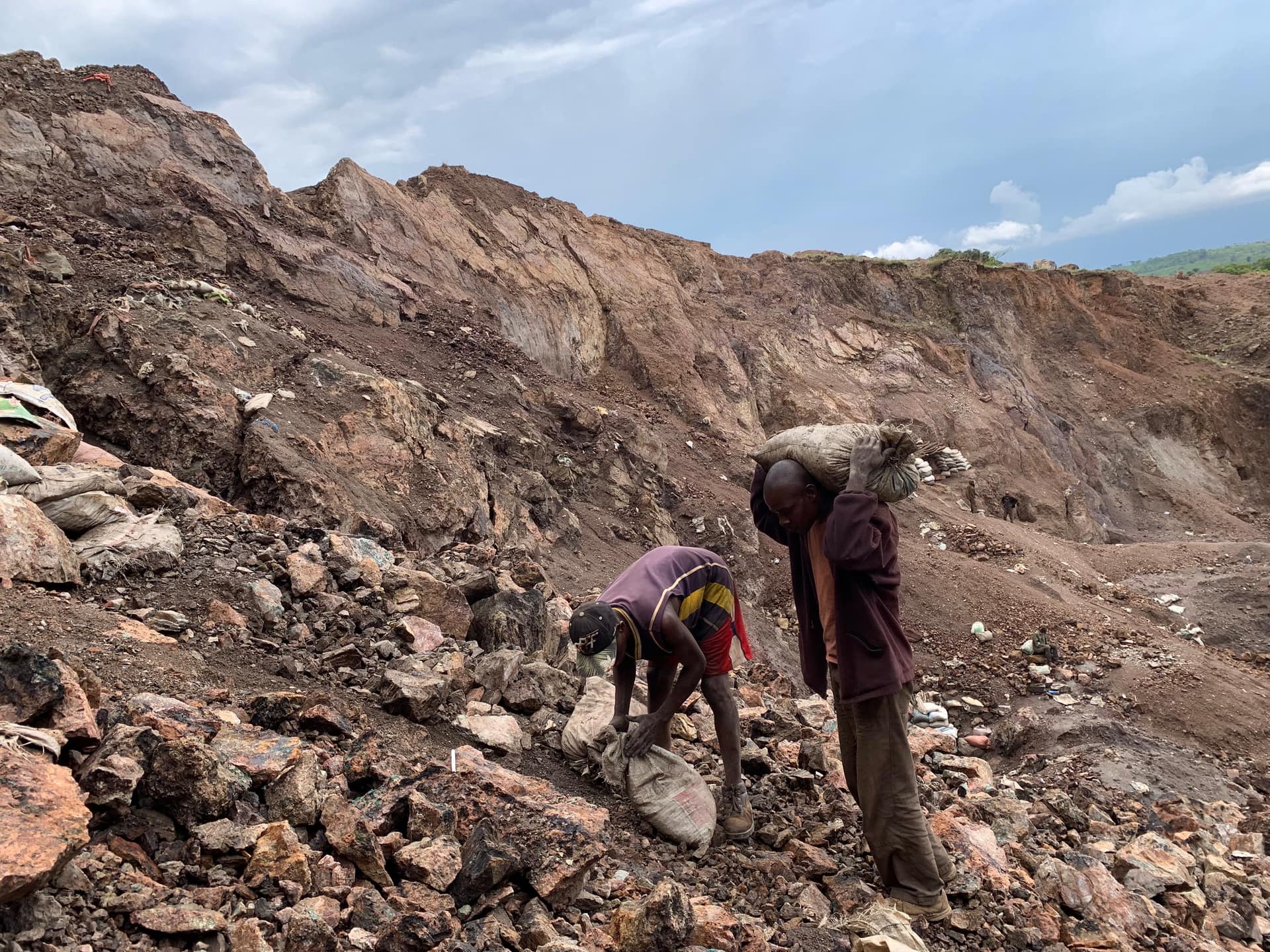
Artisanal cobalt miners in the DRC. RMI’s ASM Cobalt Criteria, written for exactly this production, has been described as a draft since February 2023.
Photo: The International Institute for Environment and Development (IIED), via Wikimedia Commons, CC BY 2.5
A programme inside the Responsible Business Alliance.
RMI has no legal existence of its own. It is a programme inside Responsible Business Alliance Inc, a US non-profit business league registered under EIN 26-1417796, exempt under section 501(c)(6) since February 2010 and domiciled in Alexandria, Virginia. That is why a question as simple as “where is RMI based?” has no answer on RMI’s own website: the answer is in an IRS filing, not an about page.
That filing carries the fact this page thinks matters most. In the year to December 2024 the parent body reported revenue of $33,431,026 against expenses of $33,490,235 — a small operating deficit — with net assets of $11,127,896. Contributions were zero. Ninety-nine point two per cent of income, $33,159,576, came from programme services. The body that assesses the industry is funded, almost to the last dollar, by the industry it assesses. That is not a scandal and it is the ordinary structure of industry assurance; it is simply a fact a reader should have when weighing what a conformance finding is worth.
It began in 2008 as the Conflict-Free Sourcing Initiative, founded under the Electronic Industry Citizenship Coalition, and took its present name in October 2017 when EICC rebranded as the Responsible Business Alliance. CFSI carried “over 360 member companies” at the rename; RMI reported 526 members for 2025.
Its public site has no governance page. The URL where one would sit returns a 404, and the About menu — identical on every page this Hub fetched — offers RMI Overview, Join RMI, Members, Contact, RBA Foundation and RMI Funds, and GDPR Compliance, and nothing else. A body called the Steering Committee demonstrably exists and does real work: RMI’s own documents record it reviewing the interoperability strategy and formally approving the ASM Cobalt Criteria alongside the DRC Minister of Mines. Who sits on it, and how they get there, RMI does not publish. Rosters circulate in search results; none of them is on a page this Hub could open, so none of them is printed here.
Nothing reaches an audit without a self-assessment first.
RMAP, the assessment process.
The Responsible Minerals Assurance Process audits smelters and refiners against RMI’s standards, through third-party assessment firms RMI approves, firm by firm and assessor by assessor. RMI reported 222 assessments in 2025.
The conformant and active lists.
RMI publishes which facilities have passed. “Conformant” means critical findings were sufficiently addressed at an initial assessment and no zero-tolerance findings arose. The lists sit behind a terms-of-use gate and render client-side, so an ordinary visitor cannot read them in a browser, a real limitation on a dataset the whole chain cites.
The Risk Readiness Assessment.
A self-assessment and self-reporting tool covering 33 ESG issues in three pillars, whose criteria guide RMI develops jointly with the Copper Mark. It is a self-assessment, and it is compulsory: RMI requires a facility to self-assess against it before any RMI assessment, the report being valid two years.
The ASM Cobalt Criteria.
Developed 2020–2022 with the Global Battery Alliance, the Fair Cobalt Alliance, the Responsible Cobalt Initiative and DRC government and stakeholder representatives, to set “a baseline of safe, formal artisanal production” with thresholds at which investment is needed. RMI acted as Project Management Office for the GBA’s Cobalt Action Partnership during its development.
A grievance mechanism.
Open to members, stakeholders and the public, with an anonymous route, covering the initiative, the audit programme, protocols, audit quality and assessor competence. For smelters and refiners it routes to the Minerals Grievance Platform, run jointly with the LBMA and the Responsible Jewellery Council.
The reporting templates.
The Conflict Minerals Reporting Template and the Extended Minerals Reporting Template are the industry’s standard instruments for passing supply-chain data down a chain: the format in which most companies answer their customers’ conflict-minerals questions at all.
Built for conflict minerals, later stretched to cobalt.
- 2008
Founded as the Conflict-Free Sourcing Initiative, under the Electronic Industry Citizenship Coalition.
- 2016
The OECD pilots an alignment assessment of five volunteering industry programmes. RMI is rated NOT ALIGNED with the OECD Due Diligence Guidance, alongside DMCC and the Responsible Jewellery Council.
- 2017
EICC becomes the Responsible Business Alliance on 17 October, and CFSI, then carrying over 360 member companies, becomes the Responsible Minerals Initiative.
- 2018
The Cobalt Refiner Supply Chain Due Diligence Standard is released as a pilot version on 15 August, prepared jointly with the Responsible Cobalt Initiative. The OECD re-assesses the revised standards and lifts RMI to Partially Aligned.
- 2021
Version 2.0 of the cobalt standard is published on 19 August with RCI, effective 1 January 2022, adding a step on community engagement with artisanal miners.
- 2023
The ASM Cobalt Criteria reach pilot-tooling stage in February, with the DRC government developing a list of sites for pilot implementation. The page has not been updated since.
- 2025
Two new metal-agnostic standards are released on 30 April. RMI reports 526 members, 222 assessments and 16 grievances for the year.
- 2026
From 1 January RMI stops offering assessments against four metal-specific standards, the Cobalt Refiner Standard among them. In April, nine civil-society organisations write to RMI asking it to require disclosure of suppliers in red-flag locations.
The cobalt standard was retired on 1 January 2026.
The single most consequential fact on this page is on RMI’s own standards page, in its own words: “As of 1 January 2026, the RMI will no longer offer assessments against the following standards”. The Cobalt Refiner Supply Chain Due Diligence Standard is the first of four named, and it no longer appears in the current-standards table at all.
It would be easy, and wrong, to read that as the cobalt audit route closing. Three other standards went with it — the joint copper, lead, molybdenum, nickel and zinc standard, the mica processors standard, and the tin smelter criteria — and two new metal-agnostic standards were released in April 2025. This is a consolidation: cobalt-specific assessment folds into an all-minerals architecture built around the Global Responsible Sourcing Due Diligence Standard, which RMI has recognised by the London Metal Exchange. The Cobalt Institute’s own 2025 market report describes the same transition independently. What ends is the cobalt-specific instrument, not assessment of cobalt refiners.
On how well the assessment works, the only independent evaluation this Hub could obtain is the OECD’s. Its 2016 pilot rated RMI not aligned with the OECD Guidance. After a year of revision the OECD re-assessed the standards — and only the standards — and rated RMI partially aligned in 2018, praising its programme management, its use of leverage upstream and downstream, and its transparency, while asking it to build a robust mechanism for evaluating third-party upstream programmes, to ensure companies and auditors actually implement the revised standards, and to strengthen audit requirements and assessor competence. Two things must be said with that rating. Participation was voluntary, five programmes having put themselves forward. And the OECD states plainly that because implementation could not be re-assessed, it was impossible for any programme to reach “fully aligned” in the exercise — so partial alignment is not a pass mark, and no programme got a better one.
That assessment covered tin, tantalum, tungsten and gold. It did not cover cobalt. This Hub could not establish whether the re-assessment the OECD envisaged for 2019–20 ever took place; the page that would say so is behind a challenge screen, and the question stays open here rather than being resolved in either direction.
Criticism of RMI is narrower and more recent than the criticism that circulates around industry audit schemes generally. In April 2026 nine organisations — IMPACT, Fastenaktion, Fern, Human Rights Watch, Swissaid, Mighty Earth, RAID, CAFOD and The Sentry — wrote to RMI urging it to require disclosure of suppliers in OECD red-flag locations, as the LBMA now does for gold refiners. The same letter credits RMI with “an important role in operationalizing the OECD Guidance”. This Hub found no RMI reply and did not establish that none exists.
One correction worth making plainly, because the error is easy and would be defamatory. Global Witness’s much-cited 2022 release about a “failing responsible mineral scheme” is about ITSCI. Read in full, it does not mention RMI or RMAP once. It does not transfer.
Finally, RMI’s most DRC-facing programme is also its stalest. The ASM Cobalt Criteria page still describes the standard as “currently in draft form”, and its most recent dated statement is from February 2023. For a hub whose subject is Congolese artisanal cobalt, the distance between that ambition and that date is part of the record.
Neither CMOC nor Huayou Cobalt is a member.
RMI publishes its roster in four categories: company members, vendor supporters, association partners and association members. This Hub counted 521 company members on 20 September 2026; RMI’s own 2025 Impact Report gives 526 members and its overview page says “more than 500”, undated. All three figures are given here rather than reconciled. Below are the members this Hub already holds as entities.
The absence is as informative as the list. Neither CMOC nor Zhejiang Huayou Cobalt appears among RMI’s company members, nor do Eurasian Resources Group, Gécamines or Chemaf. Glencore and Umicore are members of both RMI and the Cobalt Institute; CMOC and Gécamines are in the Cobalt Institute and not here. Membership and assessment are two different questions, since RMAP assesses facilities that hold no membership, and this Hub could not read the conformant refiner list to answer that second question, because it renders client-side behind a terms gate.
More of the bodies setting cobalt’s terms.
RMI is one of several bodies setting the terms on which cobalt is assessed. Browse the full register, or tell us what is missing.